Teens and social media: what you can do without taking the phone away
Teens and social media is one of those fights that feels like it only has two settings: let it run free, or take the phone away for good. Neither one holds up for long. The American Academy of Pediatrics has a simpler path, built on real conversations instead of a single ban, and it works whether your teen is 13 or 17.
Why talking beats taking the phone away
Young teens are often afraid that if they tell a parent something went wrong online, the phone disappears. The AAP’s guidance for early teens notes that kids this age often hide problems because they’re scared of losing the device, which means confiscation can shut down exactly the conversation you need to have.
The AAP’s broader explainer on raising kids in a digital world makes a related point: setting healthy limits is genuinely hard for families, and it isn’t only a parenting failure when it slips. Long work hours, few other activities nearby, and the design of the apps themselves all push against you. Worth remembering the next time a screen-time fight makes you feel like you’re losing.
What makes these apps so hard to put down
It helps to know what you’re up against. The AAP’s policy explainer describes social platforms as built around “engagement-based designs,” things like autoplay, endless scrolling and targeted ads that aren’t built with a child’s well-being in mind. The same page points out that these features exist because companies profit from keeping kids online longer and collecting more data about them. Your teen isn’t lacking willpower when they can’t put the phone down at dinner. The app was built to make that hard.
Teens and social media: a simple frame with the 5 C’s
The AAP’s Center of Excellence on Social Media and Youth Mental Health built a five-question guide for parents, split by age. The questions are the same for young teens, ages 10 to 14, and for older teens, ages 15 to 17:
- Child: who is your teen, and why are they using this app right now?
- Content: what’s actually showing up in their feed, and is it worth their attention?
- Calm: do they use the phone to settle down or fall asleep?
- Crowding out: what does media use push aside, sleep, homework, friends?
- Communication: can you talk about this without it turning into a fight?
For younger teens, the content question is mostly about spotting fake or mean videos and unrealistic bodies, and about not lying about their age to get onto platforms meant for 13 and up. For older teens using Instagram, TikTok or whatever comes next, the content question shifts toward something they can actually act on: managing the algorithm themselves.
The child question: start by listening
The “Child” question asks you to understand who your teen is before you decide what rule applies to them. The young-teens guidance suggests being present in small moments, even brief ones like car rides, and putting your own phone away while you do it. It also reminds parents that comparing themselves to people they see online is developmentally normal for teens, not a sign something is wrong.
For older teens, the same question shows up as patience rather than advice. If your teen tells you about a conflict with a friend, the AAP suggests asking “How did you feel?” instead of jumping to “Let’s take your phone away then.” That line gets quoted for a reason. It’s the instinct most parents have to fight.
Teaching teens to shape their own feed
This is the part a lot of parents skip, mostly because they don’t know it exists. The AAP’s guide for older teens points out that algorithms decide what shows up in a feed “for better or worse,” and that teens can push back using tools already built into the apps. Older teens can use the “I’m not interested” button, word-based content filters, and turning off algorithm-recommended content to change what they see over weeks, not instantly.
Sit down with your teen once and go through these settings together on whichever app they use most. Ten minutes does more for a bad feed than most arguments about screen time ever will, and it hands your teen a sense of control that matters more at this age than it did at 12.
Phone-free times, not phone-free kids
The “crowding out” question asks what social media bumps off the schedule. For both age groups, the AAP suggests the same handful of fixes: keep phones and gaming devices out of the bedroom at night, since that’s linked with poorer sleep, set up car rides and mealtimes as device-free, and use do-not-disturb or focus mode during school and homework so the phone stops interrupting.
None of this requires taking the device away. It requires picking a handful of times and places where nobody, parents included, is on a phone. If bedtime is the sticking point in your house, a consistent bedtime schedule for the phone itself, not just a lecture about sleep, tends to hold up better over weeks.
When social media becomes the only way to calm down
Teens use phones to escape bad feelings. That’s normal, and the AAP doesn’t treat it as alarming on its own. What matters is whether it’s the only tool they reach for. The young-teens guidance lists other ways to settle down, like talking to a trusted person, taking a walk, making art, or spending time with a pet, and says that if you’re worried about how your teen is coping, it’s reasonable to talk with their pediatrician about finding a therapist.
Watch for what the AAP calls problematic media use: when it becomes compulsive, gets in the way of friendships, or causes frequent arguments at home. That pattern, more than hours logged, is the signal worth raising at a pediatrician visit.
Real conversations, not interrogations
The “Communication” question is where most of this work actually happens. Both AAP age pages suggest the same opening move: ask something open-ended, like “What’s this like for you?” instead of a yes-or-no question. The older-teens page also suggests sharing your own stresses with social media and even asking your teen for feedback on how you manage your own phone use around the family. Watching a show together can open the same door, since it gives you something to react to side by side instead of face to face.
A weekly routine that does not involve confiscation
Here’s a routine built around the five C’s and the AAP’s conversation habits. It’s meant to repeat, not to be a one-time project.
- Pick one device-free window each day, car rides or dinner, and hold it for the whole household, not just the teen.
- Once a week, ask one open question instead of a rule: “What’s something weird or funny you saw online this week?”
- Once a month, sit with your teen and go through their main app’s feed controls together, using “I’m not interested” or similar tools to clean it up.
- Keep phones charging outside the bedroom at night, including your own.
- Check in on sleep, mood and friendships, not just screen time, since those are what media use actually crowds out.
- If arguments about the phone are becoming a daily event, raise it at the next pediatrician visit instead of waiting for a bigger problem.
Warning signs worth a second look
Most teenage social media use is fine most of the time. Still, a few patterns are worth noticing: sleep that keeps slipping, grades dropping alongside more time online, a teen who seems to pull back from friends they used to see in person, or fights about the phone that happen almost every day. The AAP’s broader digital-world guidance lists sleep loss, negative peer pressure and less time with family as effects tied to compulsive teen media use, and notes these can show up as school struggles or low mood. None of that proves the phone caused it on its own, but it’s reason enough to ask more questions, or to raise it with your pediatrician.
Where monitoring tools actually fit
A lot of what the AAP describes is a conversation, not a setting. Still, a few practical steps can support that conversation instead of replacing it. Before you sit down to talk, it helps to know what a teen’s phone can already see and share, which is why checking the Android privacy settings on their device is a reasonable first move.
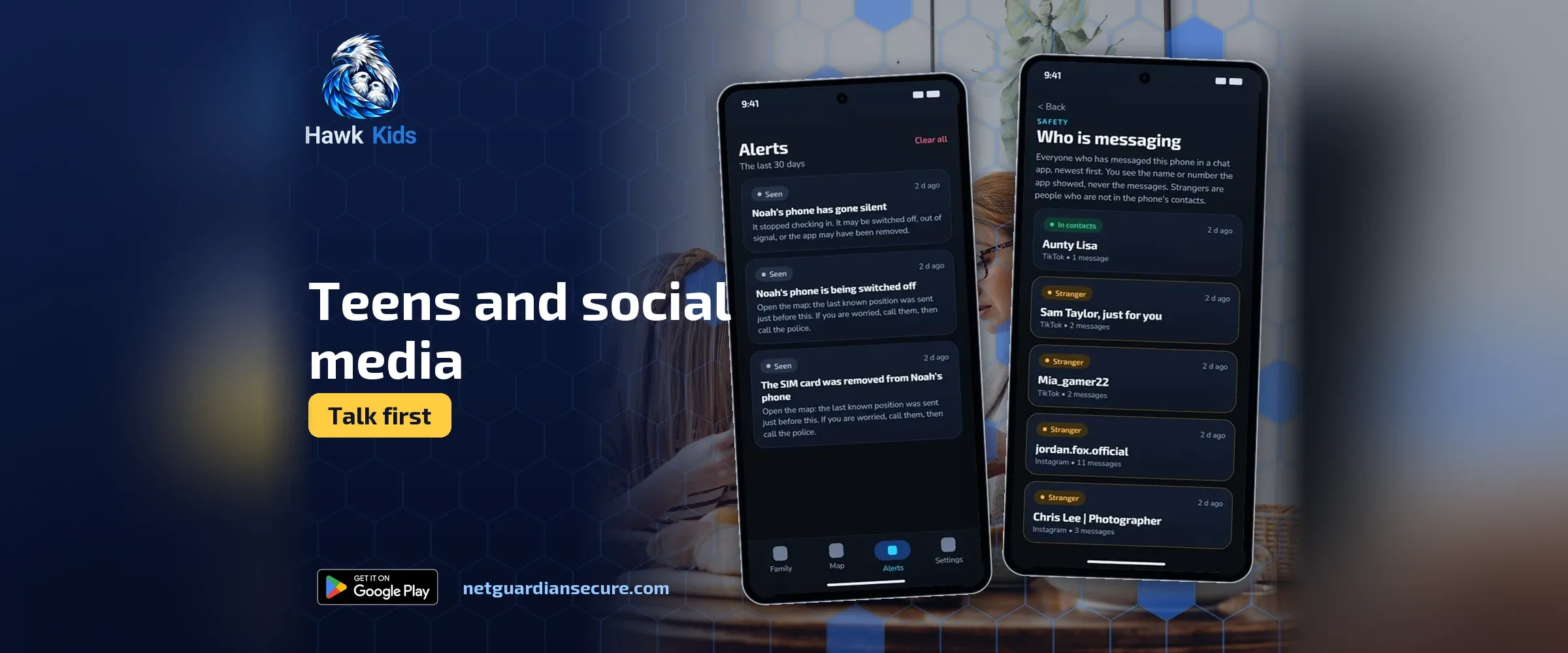
Our own company also makes Hawk Kids, an Android parental control app built for parents, not kids, despite the name. It can flag things like a new unknown contact or a message pattern that looks like pressure for pictures or money, and it can block specific apps or sites from a small starter list plus any a parent adds. It can miss sites that aren’t on those lists, so it isn’t a stand-in for the content checks and conversations above. What it’s good for is giving a parent something concrete to open a conversation with, not a reason to skip that conversation. If you’re deciding how to bring any of this up without your teen feeling watched, monitoring a phone openly instead of in secret tends to hold up better over time than a tool a teen later finds on their own.
If your teen is still younger and you’re deciding whether they need a phone at all yet, the actual guidance on what age a kid should get a phone is a better starting point than pressure from other parents in the group chat.
Sources
- AAP 5 C’s for young teens: the five C’s questions, fear of losing the phone, sleep and bedroom device advice, calming strategies, pediatrician referral.
- AAP 5 C’s for older teens: algorithm management tools, communication tips, avoiding “take the phone away” responses, device-free times.
- AAP digital world policy explainer: engagement-based app design, effects of compulsive teen media use, the difficulty of setting limits, parental controls as one part of a family media plan.
If it isn’t for you, there’s a 7-day refund window.
Guarding your family, your business, your future.