
Cyber Security Critical Infrastructure Protection 2026
Critical infrastructure keeps modern life running. Power grids deliver electricity, water treatment plants supply clean water, hospitals treat patients, and transport networks move people and goods. When cyber attacks target these systems, the consequences ripple through entire communities. Protecting cyber security critical infrastructure has become essential work for organisations of every size, and the principles that safeguard industrial control systems also apply to the Windows networks that many small operators and support staff rely on every day.
What counts as critical infrastructure
Governments define critical infrastructure as the assets, systems and networks whose disruption would significantly harm national security, economic stability, public health or safety.
The sectors vary slightly by country, but most include:
- Energy: power generation, transmission grids, oil and gas pipelines
- Water and wastewater: treatment plants, distribution networks
- Healthcare: hospitals, clinics, pharmaceutical supply chains
- Transport: railways, airports, ports, road traffic management
- Communications: internet backbone, mobile networks, satellite systems
- Financial services: banks, payment processors, stock exchanges
- Food and agriculture: processing plants, distribution networks
Each sector depends on networked systems to function. Those networks become targets.

Why attackers target critical infrastructure
The motivations behind attacks on cyber security critical infrastructure vary. State-sponsored groups seek strategic advantage, criminal gangs demand ransoms, and hacktivists pursue political goals.
Critical infrastructure makes an attractive target because:
- Disruption creates immediate public impact and media attention
- Operational technology (OT) systems often run outdated software with known vulnerabilities
- Many organisations prioritise availability over security, creating weak points
- A single breach can cascade across interconnected systems
- Ransom payments from essential services tend to be larger
The ENISA Threat Landscape 2024 documents how ransomware, distributed denial-of-service attacks and supply-chain compromises continue to evolve. Attackers increasingly combine techniques, using initial network access to deploy multiple payloads.
Core principles for protecting critical systems
Defending cyber security critical infrastructure starts with understanding that perfect security is impossible. You build layers of protection, knowing that determined attackers will test every boundary.
Segmentation separates critical systems from general networks. An OT network controlling a water pump should never share the same segment as office computers. Physical or virtual isolation limits how far an attacker can move after initial compromise.
Least privilege restricts user and process permissions to the minimum needed for legitimate work. When an account is compromised, limited privileges reduce the damage an attacker can cause.
Defence in depth layers multiple security controls so that if one fails, others remain. This includes firewalls, intrusion detection, endpoint protection, monitoring and regular patching.
| Control Layer | Purpose | Example Technologies |
|---|---|---|
| Network perimeter | Block unauthorized access | Firewalls, VPNs, DMZs |
| Host protection | Detect and prevent endpoint threats | Antivirus, intrusion detection, application control |
| Data security | Protect sensitive information | Encryption, access controls, backups |
| Monitoring | Identify suspicious activity | SIEM, network analysis, anomaly detection |
| Recovery | Restore operations after incidents | Backups, incident response plans, failover systems |
The ISA/IEC 62443 series of standards provides a comprehensive framework for industrial automation and control systems security. While designed for large-scale OT environments, its principles (zones, conduits, risk assessment, lifecycle management) apply to any network that supports essential operations.
Practical steps for smaller operators
Not everyone manages a national power grid. Many people working in or supporting critical infrastructure use standard Windows networks in small facilities, field offices or while travelling between sites.
If you support cyber security critical infrastructure from a Windows environment, you need visibility into what connects to your network and what those connections attempt to do.
Monitor network connections actively. Intrusion detection on each PC catches suspicious outbound traffic, unauthorised connection attempts and unusual protocols. You want alerts that explain what happened in plain language, not just technical logs.
Control wireless and removable media. USB drives and Bluetooth devices bypass many network security controls. Monitoring these interfaces prevents attackers from using them as entry points or data theft routes.
Use a VPN when working remotely. Field engineers, remote managers and travelling staff often connect from hotels, cafes or other untrusted networks. A virtual private network encrypts traffic and hides your true location, reducing exposure.
Update regularly. Patching vulnerabilities in Windows, applications and firmware closes known security gaps. Attackers scan for unpatched systems because exploitation is straightforward.
The CISA ICS recommended practices offer vetted guidance on patching strategies, remote access controls and defence-in-depth implementation specifically for industrial control systems. The principles translate well to any environment where uptime and reliability matter.
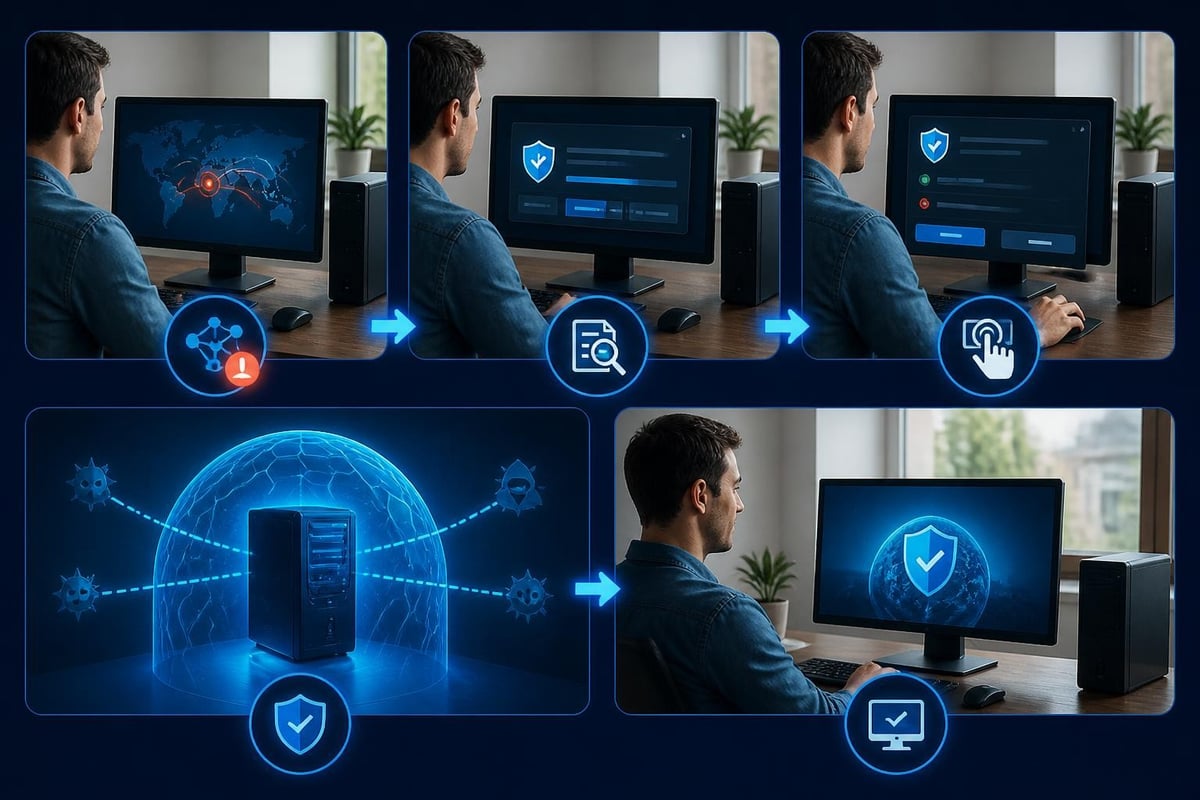
Threat intelligence and anomaly detection
Knowing what threats exist helps you recognize them when they appear. Threat intelligence feeds provide indicators of compromise (file hashes, IP addresses, domain names) associated with known attack campaigns.
When your intrusion detection compares network activity against threat intelligence, it can flag connections to command-and-control servers, known malware distribution sites or data exfiltration endpoints before significant damage occurs.
Behavioural analysis complements signature-based detection. By learning normal network patterns for each PC, an adaptive system can alert you to deviations: a laptop that usually accesses three local servers suddenly connects to 50 external IPs, or a workstation begins encrypting files at an unusual rate.
Ransomware targeting cyber security critical infrastructure often starts with reconnaissance. Attackers map the network, identify valuable data and locate backups before encrypting systems. Behavioural monitoring catches these preparatory steps, giving you time to respond.
Managing false positives
Any detection system generates some false alarms. The challenge is tuning sensitivity so you catch real threats without drowning in irrelevant alerts.
Adaptive learning helps. When a system observes normal behaviour over days or weeks, it builds a baseline. Alerts triggered by deviations from that baseline tend to be more relevant than alerts based solely on generic rules.
You still need clear information when an alert fires. An explanation like "Process XYZ attempted to contact IP 203.0.113.45, which is associated with the Emotet botnet" is actionable. A cryptic error code is not.
Incident response and recovery
When a cyber security critical infrastructure incident occurs, speed matters. You need to contain the breach, assess the damage, restore operations and understand how the attack succeeded so you can prevent recurrence.
A basic incident response plan includes:
- Detection and analysis: Confirm the incident is real, determine its scope and classify severity.
- Containment: Isolate affected systems to prevent further spread.
- Eradication: Remove the attacker's access and malicious code.
- Recovery: Restore systems from clean backups or rebuild them.
- Lessons learned: Document what happened and update defences accordingly.
For many smaller operators, the most practical containment step is network isolation. Disconnecting a compromised PC from the network (while leaving it powered on for forensic analysis) stops lateral movement. You want this capability built into your security tools so you can act immediately.
| Response Stage | Key Actions | Common Challenges |
|---|---|---|
| Detection | Review alerts, correlate events, verify indicators | Alert fatigue, lack of context |
| Containment | Isolate systems, block connections, preserve evidence | Balancing availability and security |
| Eradication | Remove malware, close vulnerabilities, reset credentials | Hidden persistence mechanisms |
| Recent joint guidance on OT cybersecurity principles from international partners emphasizes the importance of cross-agency coordination and sharing threat information. When defending cyber security critical infrastructure, you benefit from understanding what attacks others have faced and how they responded. |
Backup strategies that survive attacks
Ransomware attackers delete or encrypt backups when they can. Your backup strategy must account for this.
Air-gapped backups stored offline or on write-once media remain safe from network-based attacks. Even if your entire network is compromised, you can rebuild from clean snapshots.
Versioned backups let you roll back to a point before the infection. If ransomware encrypted your files on Tuesday but backups ran Monday, you lose at most one day of work.
Test your restore process regularly. Backups are worthless if you cannot actually recover from them under pressure.
Human factors in critical infrastructure security
Technology alone does not secure cyber security critical infrastructure. People make decisions that either strengthen or weaken defences.
Awareness training teaches staff to recognize phishing emails, suspicious links and social engineering attempts. Attackers often gain initial access by tricking someone into opening a malicious attachment or entering credentials on a fake login page.
Clear policies define acceptable use, outline security responsibilities and establish consequences for violations. When everyone understands the rules, accidental breaches become less common.
Practical tools reduce the burden of security. If enabling protection requires a computer science degree, people will skip it. If checking for threats takes one click and delivers a plain-language report, compliance improves.
The World Economic Forum’s Global Cybersecurity Outlook 2024 highlights the widening gap between well-resourced organisations and those with limited budgets or expertise. Smaller operators face the same threats as major utilities but with fewer specialists and tighter margins. Practical, affordable protection becomes essential.
Regulatory and compliance considerations
Many jurisdictions now mandate security controls for cyber security critical infrastructure. In the United States, CISA issues binding operational directives. The European Union's NIS2 Directive expands requirements across member states. Industry-specific regulations (NERC CIP for power, HIPAA for healthcare) add further obligations.
Compliance frameworks typically require:
- Risk assessments identifying critical assets and vulnerabilities
- Security controls implementing technical and procedural safeguards
- Incident reporting notifying authorities of breaches within specified timeframes
- Regular audits demonstrating ongoing adherence to standards
Meeting these requirements protects you legally and improves security posture. A documented risk assessment forces you to inventory assets and prioritize protections. Mandatory incident reporting ensures you have detection and response capabilities in place.
For smaller operators, the key is proportionality. You implement controls appropriate to your environment and risk. A two-person water treatment facility does not need the same security operations center as a national telecom provider, but both need network monitoring, patching and backups.
The path to cyber security critical infrastructure compliance: risk assessment, control implementation, staff training, monitoring deployment, incident response planning, and audit preparation
Supply chain and third-party risks
Cyber security critical infrastructure rarely operates in isolation. Vendors supply equipment, contractors perform maintenance, and cloud services host data. Each connection introduces risk.
Vendor assessment evaluates the security practices of suppliers before you engage them. Do they patch their products promptly? Do they notify customers of vulnerabilities? Do they require secure authentication for remote support access?
Contractual requirements establish security obligations. Service-level agreements can mandate encryption, access logging, incident notification and liability for breaches caused by vendor negligence.
Access controls limit what third parties can reach. A contractor updating SCADA software needs access to the control network, but only during scheduled maintenance windows and only to specific systems. Remote access should require VPN, multi-factor authentication and session logging.
The SANS Institute’s critical controls for the electric sector emphasize vendor management as a foundational practice. Attackers increasingly compromise supply chains to reach well-defended targets. Your suppliers' security becomes your security.
Emerging threats and future considerations
Cyber threats evolve constantly. Attackers develop new techniques, exploit fresh vulnerabilities and target previously ignored systems.
IoT devices proliferate in critical infrastructure. Sensors, meters and controllers often ship with default credentials, unpatched firmware and no update mechanism. Each becomes a potential entry point.
Cloud adoption shifts infrastructure from on-premises systems to shared platforms. This introduces new security responsibilities (identity management, API security, data sovereignty) while reducing others (physical security, some patching).
AI-powered attacks use machine learning to automate reconnaissance, craft convincing phishing messages and adapt evasion techniques in real time. Defenders must also adopt intelligent tools to keep pace.
Protecting cyber security critical infrastructure in 2026 and beyond requires continuous learning. You monitor threat trends, evaluate new security technologies and adjust your defences as the landscape shifts.
Bringing protection to your network
Whether you manage a small utility, support field operations or travel between critical infrastructure sites, your Windows PC or laptop is part of the defence perimeter. NetGuardian Pro runs 14 detection modules directly on your Windows 11 device, monitoring network connections for suspicious activity involving Wi-Fi, USB and Bluetooth.
The software includes ransomware behaviour monitoring, threat intelligence integration and clear alerts that explain what happened in everyday language. When something suspicious occurs, you get blocking controls and the option to isolate your PC immediately. Hawk Sense learns your normal network activity to reduce false alarms, so you focus on real threats. A built-in WireGuard VPN protects you when working from untrusted networks, essential for anyone travelling between sites or working remotely. You pay once with no subscription, and free updates and email support are included. NetGuardian Pro complements your antivirus software rather than replacing it, adding a dedicated layer of network intrusion detection and prevention to your security posture. For more information, visit the NetGuardian Pro product page.
Protecting cyber security critical infrastructure requires layered defences, continuous monitoring and practical tools that work for real people in real environments. Whether you operate essential services or support those who do, your Windows network deserves the same vigilance as any industrial control system. NetGuardian Pro delivers intrusion detection, ransomware monitoring and VPN protection directly on your Windows 11 PC, giving you visibility and control over network threats without requiring an IT background. One-time purchase, no subscription, and support when you need it.
Related reading: Auto Cyber Security: What You Need to Know in 2026, Attack Surface Cyber Security: Your Protection Guide, Cyber Security IDS: Protection for Windows Networks.