
Cloud Networking and Security: A Practical Guide
Cloud networking and security has become a central concern for anyone managing data and systems in 2026. Whether you run a small business, work remotely, or manage your family's devices, understanding how cloud networks operate and where vulnerabilities emerge helps you make informed decisions. This guide walks you through the fundamentals, practical controls, and emerging patterns that shape secure cloud connectivity today.
Understanding cloud networking fundamentals
Cloud networking connects your devices, applications, and data across virtual infrastructure hosted by providers like AWS, Azure, and Google Cloud. Unlike traditional networks confined to a physical office, cloud networks span data centres worldwide, use software-defined routing, and scale on demand.
Key components include:
- Virtual private clouds (VPCs) that isolate your resources
- Software-defined networking (SDN) that automates traffic routing
- Load balancers that distribute traffic across servers
- Internet gateways and VPN endpoints for connectivity
- Network access control lists (ACLs) and security groups
When you access cloud services, your traffic flows through multiple layers. Understanding this architecture helps you spot where threats can enter and where controls belong.
How cloud networks differ from traditional setups
Traditional networks operate within defined perimeters. You control the physical hardware, know every device, and trust everything inside your firewall.
Cloud networks challenge this model. Your workloads run on shared infrastructure. Traffic crosses public internet. Users connect from anywhere. The perimeter dissolves.
This shift demands new security thinking. Zero Trust access control in cloud environments treats every connection as potentially hostile, verifying identity and context continuously rather than assuming trust based on location.

Cloud networking and security risks you need to know
Several distinct threat categories target cloud networks. Recognising them helps you prioritise defences.
Misconfiguration remains the leading cause of breaches. A storage bucket left public, a security group rule too permissive, or an API endpoint unprotected can expose sensitive data in minutes.
Lateral movement occurs when an attacker gains initial access to one cloud resource and pivots to others. Without proper segmentation, a compromised virtual machine can reach databases, secrets, and production systems.
Data exfiltration happens when unauthorised parties extract information through network channels. Attackers may compress, encrypt, or disguise stolen data to evade detection.
| Risk category | Common attack vector | Primary mitigation |
|---|---|---|
| Misconfiguration | Public storage, overpermissive rules | Configuration audits, policy-as-code |
| Lateral movement | Compromised credentials, weak segmentation | Micro-segmentation, least privilege |
| Data exfiltration | Command-and-control channels, DNS tunnelling | Network monitoring, traffic analysis |
| Account takeover | Credential stuffing, phishing | Multi-factor authentication, anomaly detection |
Identity and access vulnerabilities
Cloud networking and security converge at identity. If credentials leak or tokens get stolen, network controls alone cannot stop unauthorised access.
Strong identity practices include multi-factor authentication, short-lived tokens, and role-based access policies. When combined with network segmentation, these controls limit blast radius even if one account falls.
Implementing Zero Trust in cloud networks
Zero Trust architecture assumes breach and verifies explicitly. It replaces implicit trust with continuous validation of users, devices, and applications.
The NIST guide to Zero Trust implementation outlines a practical framework for hybrid and multi-cloud environments. Core principles include:
- Verify explicitly using all available data points (identity, device health, location, behaviour)
- Use least privilege access granting minimal permissions necessary for each task
- Assume breach designing controls that contain and detect compromised assets
In practice, this means treating your cloud VPC the same way you treat the public internet. No automatic trust for internal addresses. Every connection authenticated and authorised.
Micro-segmentation for granular control
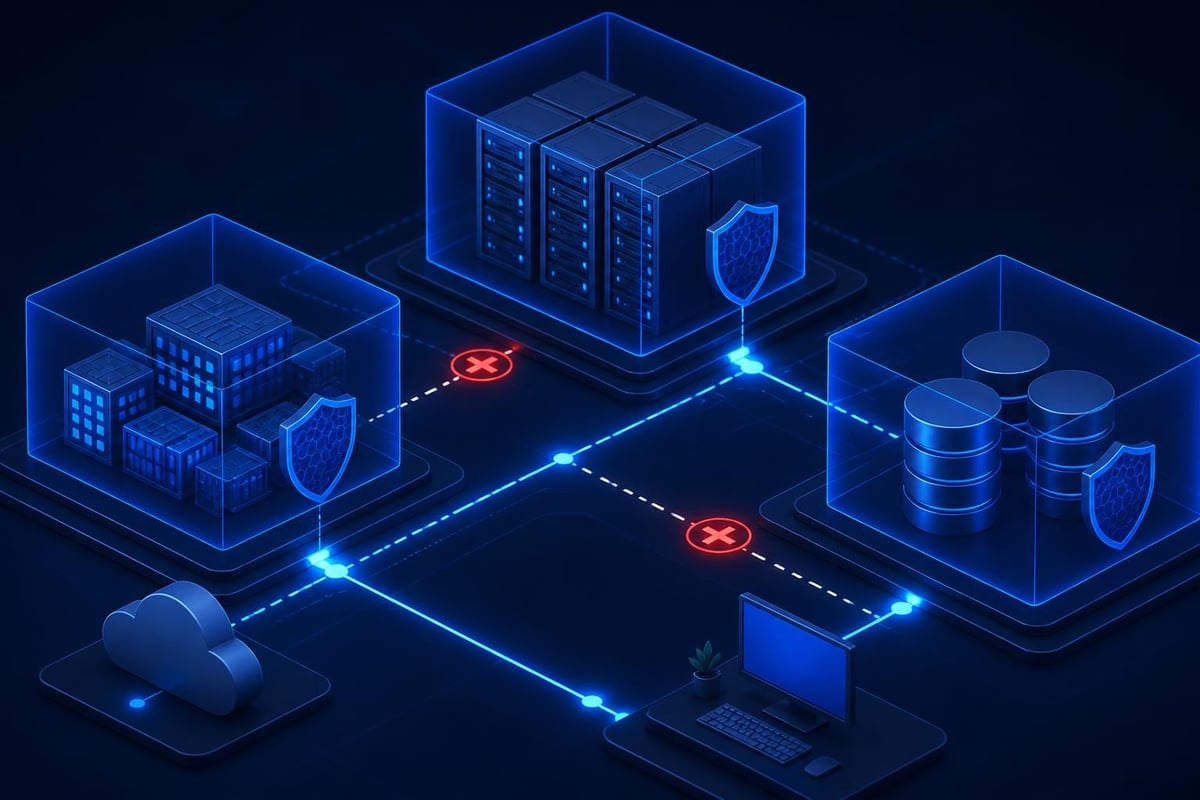
Micro-segmentation divides cloud networks into small, isolated zones with specific access policies. Unlike broad VLANs, micro-segments can protect individual workloads or even single containers.
Benefits of micro-segmentation:
- Limits lateral movement by containing breaches
- Enforces least privilege at the network layer
- Simplifies compliance by isolating regulated data
- Reduces attack surface through isolation
Cloud platforms provide tools for micro-segmentation through security groups, network policies, and service mesh configurations. Properly configured, these controls create defense-in-depth layers that slow or stop attackers.
Practical controls for securing cloud networks
Securing cloud networking and security requires layered controls that address traffic, configuration, and monitoring.
Network access controls and firewalls
Cloud-native firewalls inspect traffic at VPC boundaries and between segments. Unlike physical appliances, these firewalls scale automatically and integrate with cloud management APIs.
AWS VPC security best practices recommend combining security groups (stateful, instance-level) with network ACLs (stateless, subnet-level) for layered protection. This approach provides both fine-grained control and broad policy enforcement.
For multi-cloud deployments, consistent firewall policies across providers reduce configuration drift and simplify audits. Tools that translate policies into platform-specific rules help maintain security posture across AWS, Azure, and Google Cloud.
Encryption in transit and at rest
All traffic crossing cloud networks should use encryption. TLS 1.3 for application traffic, IPsec or WireGuard for VPN tunnels, and MACsec for physical links provide confidentiality and integrity.
Data at rest in cloud storage and databases also requires encryption. Most cloud providers offer default encryption, but you retain responsibility for key management and access control to encrypted resources.
Key encryption considerations:
- Use provider-managed keys for convenience or customer-managed keys for control
- Rotate encryption keys regularly according to policy
- Monitor key usage and access patterns for anomalies
- Document key recovery procedures for business continuity
Monitoring and threat detection in cloud networks
Visibility into network traffic and security events underpins effective cloud security. Without monitoring, you cannot detect anomalies, investigate incidents, or prove compliance.
Cloud providers offer native monitoring services that capture flow logs, DNS queries, and API calls. These logs feed security information and event management (SIEM) systems or cloud-native analytics platforms.
Building effective detection rules
Generic alerts create noise. Effective detection rules focus on high-fidelity signals that indicate genuine threats or policy violations.
Detection priorities for cloud networks:
- Unusual outbound connections to new destinations
- Large data transfers outside normal patterns
- Access attempts to restricted resources
- Configuration changes to security controls
- Failed authentication attempts above baseline
Behavioural analysis improves accuracy by learning normal patterns and flagging deviations. Machine learning models can identify anomalies that signature-based rules miss, such as slow data exfiltration or reconnaissance activity.
| Detection method | Strengths | Limitations |
|---|---|---|
| Signature-based | Fast, low false positives | Misses novel attacks |
| Anomaly-based | Catches unknown threats | Requires training period |
| Behaviour analysis | Adapts to environment | Complex to tune |
| Threat intelligence | Proactive blocking | Depends on feed quality |
Responding to cloud network incidents
When monitoring detects suspicious activity, you need clear response procedures. Cloud environments offer unique containment options unavailable in physical networks.
Incident response steps:
- Isolate compromised resources by modifying security group rules
- Snapshot affected instances for forensic analysis
- Rotate credentials and revoke active sessions
- Review access logs to identify scope
- Document timeline and actions for post-incident review
Automation accelerates response. Cloud APIs enable scripts that isolate resources, block IPs, or trigger alerts within seconds of detection. Pre-built playbooks reduce decision fatigue during incidents.
Configuration hardening and compliance
The CIS Benchmarks provide prescriptive guidance for hardening cloud platform components. These benchmarks cover networking services, identity systems, and logging configurations.
Regular audits verify configuration against security baselines. Infrastructure-as-code tools like Terraform or CloudFormation embed security controls in templates, preventing drift and enabling version control of network policies.
Common misconfigurations to avoid
Cloud networking and security failures often stem from preventable configuration errors. Understanding these patterns helps you audit existing setups and design new deployments securely.
High-risk misconfigurations include:
- Default security groups that allow unrestricted inbound access
- Overly broad network ACLs permitting unnecessary protocols
- Disabled logging for network flow or DNS queries
- Public IP addresses assigned to internal resources
- Unencrypted traffic between cloud services
- Shared credentials for automation and service accounts
Policy-as-code tools validate configurations before deployment. They catch errors in testing environments, preventing security gaps from reaching production. Continuous compliance scanning detects drift and alerts when resources violate policies.

Securing hybrid and multi-cloud connectivity
Many organisations operate hybrid environments connecting on-premises networks to multiple cloud providers. This complexity introduces additional security challenges.
Google Cloud’s VPC design best practices emphasise consistent security controls across environments. Whether traffic flows between data centres or cloud regions, the same verification and encryption standards should apply.
VPN and private connectivity options
Cloud providers offer several connectivity models. Internet-based VPNs provide encrypted tunnels over public networks. Direct connections like AWS Direct Connect or Azure ExpressRoute use dedicated circuits for predictable performance and security.
For remote workers and small offices, cloud-managed VPN services simplify deployment. These services integrate with cloud identity systems, enforce policy, and scale automatically.
Built-in VPN capabilities in endpoint protection tools can extend cloud security to mobile devices. When employees travel or work from public Wi-Fi, VPN encryption protects data in transit and maintains secure connectivity to cloud resources.
Managing security across multiple clouds
Multi-cloud strategies distribute workloads across providers for resilience, cost optimisation, or feature access. However, each cloud platform uses different terminology, APIs, and security primitives.
The Cloud Security Alliance’s Security Guidance v5 offers comprehensive best practices for multi-cloud security. Key recommendations include centralised identity federation, unified policy management, and consistent monitoring across platforms.
Abstraction layers and cloud management platforms help normalise security controls. They translate high-level policies into provider-specific configurations, reducing complexity and configuration errors.
Emerging threats and defence strategies
Cloud networking and security evolves as attackers develop new techniques. Staying current with threat research helps you anticipate and prepare for emerging risks.
The SANS Cloud Security Exchange whitepaper collection documents current threat trends and recommended defences. Recent research highlights supply chain attacks targeting cloud infrastructure, API vulnerabilities, and abuse of serverless computing for malicious purposes.
Supply chain and dependency risks
Cloud services depend on layers of third-party components, libraries, and integrations. A vulnerability in a widely used library or compromised software update can affect thousands of cloud deployments simultaneously.
Supply chain security measures:
- Validate signatures and checksums for downloaded components
- Scan container images for known vulnerabilities before deployment
- Restrict egress traffic to approved destinations
- Monitor dependency updates and security advisories
- Maintain software bill of materials (SBOM) for cloud applications
Network controls complement application-layer defences. Egress filtering prevents compromised components from establishing command-and-control channels or exfiltrating data.
Serverless and container networking security
Serverless functions and containers introduce ephemeral, rapidly scaling workloads. Traditional network security models struggle with resources that exist for seconds or minutes.
Research on microsegmented cloud architectures explores applying Zero Trust principles to container and serverless environments. Techniques include:
- Service mesh integration for encrypted inter-service communication
- Runtime security policies that validate network connections
- Immutable infrastructure preventing post-deployment modification
- Ephemeral credentials tied to function execution lifetime
These patterns secure modern cloud-native applications while maintaining flexibility and scalability.
Practical security for Windows devices in cloud environments
Many cloud users access resources from Windows laptops and PCs. Securing the endpoint complements cloud networking and security controls, creating defense-in-depth protection.
Windows devices connecting to cloud services face risks from malicious networks, compromised Wi-Fi, and network-based attacks. Local network monitoring can detect suspicious connections before they reach cloud resources.
Endpoint security tools that monitor Wi-Fi, USB, and Bluetooth connections help identify threats at the device level. Combining threat intelligence with behavioural analysis reduces false alarms while catching genuine attacks. For users without dedicated IT teams, clear alerts and blocking controls make network threats understandable and actionable.
When travelling or working from public locations, VPN capabilities protect cloud traffic from interception. Encrypting connections between the device and cloud services prevents eavesdropping and man-in-the-middle attacks on untrusted networks.
Choosing cloud security controls that fit your needs
Not every organisation needs enterprise-grade cloud security platforms. Small businesses, home users, and travellers benefit from practical controls matched to their risk profile and technical expertise.
Selection criteria for cloud security tools:
- Clarity of alerts and actionable information
- Integration with existing workflows and tools
- Cost structure (subscription vs. one-time purchase)
- Support and update policies
- Compatibility with your devices and cloud services
Microsoft’s Azure network security best practices provide prescriptive recommendations for organisations using Azure. Similar guidance exists for AWS and Google Cloud, tailored to each platform's specific services and controls.
For individuals and families, endpoint protection that monitors network activity complements cloud-provider security. This layered approach catches threats that cloud controls miss, particularly when devices move between networks or connect to untrusted Wi-Fi.
Building a sustainable cloud security practice
Cloud networking and security requires ongoing attention. Threats evolve, configurations drift, and new services introduce fresh attack surfaces. Sustainable security balances thoroughness with practicality.
Core practices for long-term success:
- Regular configuration audits against security benchmarks
- Automated compliance monitoring with actionable alerts
- Incident response procedures tested through tabletop exercises
- Security training for everyone who configures or uses cloud resources
- Documentation of network architecture, policies, and procedures
Start with high-impact controls like multi-factor authentication, encryption in transit, and basic monitoring. Expand coverage gradually based on risk assessment and available resources.
Balancing security and usability
Overly restrictive controls frustrate users and encourage workarounds. Effective cloud security enables productivity while managing risk.
Contextual access policies adapt security based on user behaviour, device health, and data sensitivity. Low-risk activities face minimal friction. High-risk scenarios trigger additional verification without blocking legitimate work.
Clear communication about security controls builds understanding and compliance. When people know why restrictions exist and how to work within them, they become partners in security rather than obstacles to overcome.
Cloud networking and security demands attention to architecture, configuration, and monitoring across diverse environments. By implementing Zero Trust principles, micro-segmentation, and continuous monitoring, you create resilient defenses against evolving threats. For Windows users, NetGuardian Pro extends cloud security to the endpoint with network intrusion detection, ransomware monitoring, and built-in VPN protection that complements your cloud controls without requiring IT expertise.
Related reading: Internet Security in Business: A Practical 2026 Guide, Cloud Based Cyber Security Companies: A Practical Guide, Cybersecurity and Networking: Practical Protection Guide.