Silica dust on the job: what concrete, stone and tile workers should know
If you cut, grind, drill or demolish concrete, stone, brick or tile for a living, you’ve breathed in dust that looks harmless but isn’t. Silica dust safety for contractors isn’t a topic most small operators think about until a doctor brings it up, and by then the damage is already done. This post lays out what the dust is, which tasks create it, what it can do to your lungs, and the controls that actually cut your exposure. This is general information pulled from OSHA and NIOSH, not medical or legal advice, so if you have symptoms or questions about your specific job, talk to a doctor or an occupational safety professional.
What crystalline silica actually is
Crystalline silica is a common mineral found in the earth’s crust, and it shows up in sand, stone, concrete and mortar. It’s also in glass, pottery, ceramics, bricks and artificial stone. In other words, it’s in most of the materials a concrete, stone or tile contractor handles every day.
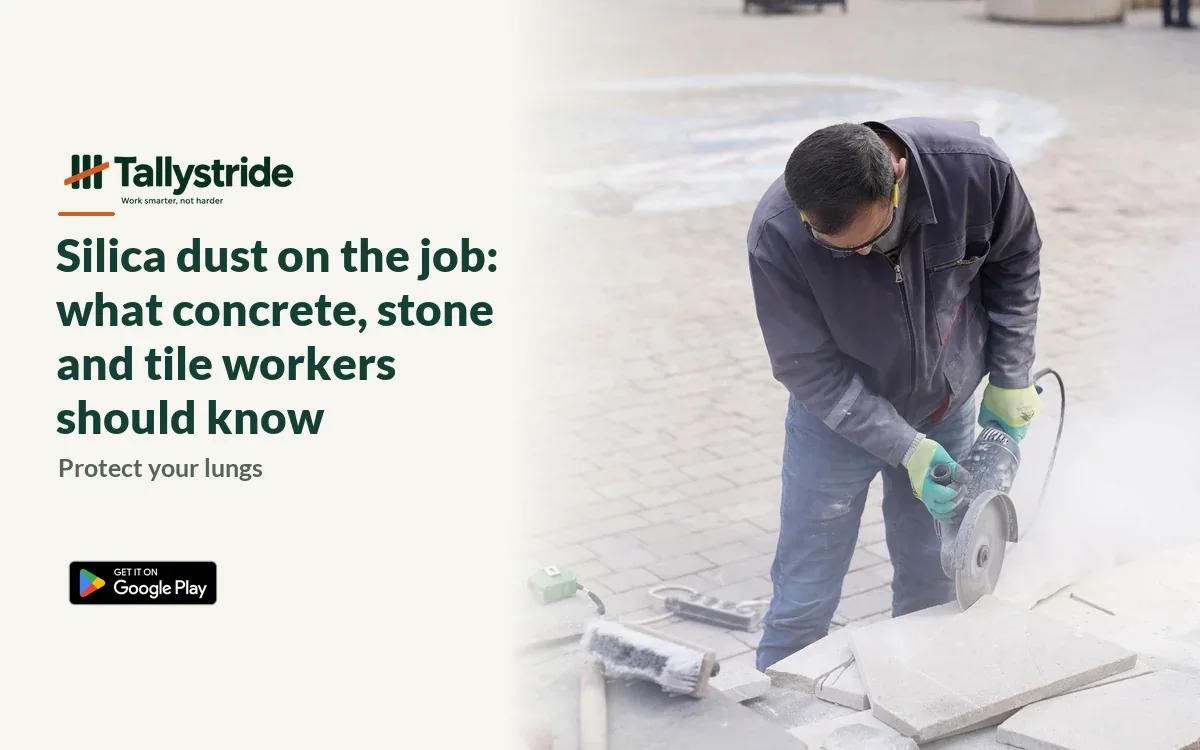
The problem isn’t the material sitting still. It’s what happens when you cut into it. Respirable crystalline silica is created by cutting, sawing, grinding, drilling and crushing stone, rock, concrete, brick, block and mortar, and those particles are at least 100 times smaller than the sand you’d find on a beach. You can’t see most of it floating in the air. That’s what makes it dangerous: the dust fine enough to do harm is also fine enough to be invisible until it’s already in your lungs.
NIOSH describes it the same way: work activities such as cutting, grinding, polishing and drilling generate dust from materials containing silica, and that dust becomes airborne. Once it’s airborne, anyone working nearby, including you, is breathing it.
Which jobs create silica dust
If your work involves any of the following, you’ve likely created or been exposed to respirable silica dust on the job:
- Abrasive blasting with sand
- Sawing brick or concrete
- Sanding or drilling into concrete walls
- Grinding mortar
- Cutting or crushing stone
- Manufacturing brick, concrete block, stone countertops or ceramic products
OSHA lists all of these as activities that result in worker exposure to respirable crystalline silica dust. NIOSH adds a longer list of settings where exposure happens, including stonecutting, rock drilling, quarry work, tunneling, foundry work and hydraulic fracturing, plus industries like construction, mining, oil and gas extraction, and natural and engineered stone countertop fabrication.
Countertop work deserves its own mention. NIOSH calls it a primary concern for exposure risk, because some engineered stone products used for kitchen and bath countertops can be made of up to 95% crystalline silica. If you fabricate, finish or install countertops, you’re working with some of the highest-silica material on a job site, and dust control stops being optional.
What the dust does to your body
This is the part that’s easy to put off thinking about, because the effects don’t show up the day you breathe the dust in. They show up years later.
OSHA names four conditions linked to inhaling respirable crystalline silica particles over time: silicosis, lung cancer, chronic obstructive pulmonary disease (COPD), and kidney disease. Silicosis is described as an incurable lung disease that can lead to disability and death. NIOSH confirms the same point in blunter terms: silicosis is not reversible, but it is preventable. NIOSH also lists certain autoimmune diseases and chronic renal failure among the diseases tied to excessive exposure.
There’s no cure once silicosis sets in. The only real control you have is on the front end, before the damage starts. That’s why the control measures below matter more than any after-the-fact fix.
OSHA estimates that about 2.3 million people in the U.S. are exposed to silica at work. If you run your own concrete, stone, tile or demolition work, you’re very likely one of them, even on days when the dust doesn’t look that bad.
Silica dust safety for contractors: the controls that work
NIOSH and OSHA both describe a layered approach rather than a single fix. For countertop work specifically, NIOSH lays out a hierarchy starting with elimination or substitution, then engineering controls, then administrative controls, then personal protective equipment as the last layer, not the first. The same logic applies to concrete, stone and tile work generally.
Here’s what that looks like on a real job:
- Choose lower-silica materials where you can. NIOSH’s top recommendation is substitution: picking stone or engineered products with less crystalline silica content when the job allows it. This isn’t always possible, since the customer often picks the material, but it’s worth raising with clients who ask about options.
- Use wet cutting methods. Wetting the material before and during cutting, sawing or grinding keeps dust from becoming airborne in the first place. NIOSH’s own hazard alert specifically points to wet-cutting methods as one of the engineering controls that reduces dust in the work environment. If your saw has a water attachment, use it, not just on days when an inspector might show up.
- Add ventilation and dust collection. Local exhaust ventilation, shrouds on grinders, and vacuum attachments on drills and saws pull dust away from the breathing zone before you inhale it. These fall under the same engineering-controls category NIOSH describes.
- Build administrative habits around the dust. This includes things like scheduling the dustiest cuts for when fewer people are nearby, rotating tasks so no one person gets the heaviest exposure all day, and training yourself and any crew on how the controls are supposed to be used. NIOSH describes nine administrative strategies in its countertop guidance, covering training and changes to procedures or scheduling.
- Wear a respirator rated for the task. PPE comes last in the hierarchy because it protects the person wearing it, not everyone on site, and it only works if it fits and is used correctly. A respirator is still worth having, especially for tasks where wet methods or ventilation can’t fully control the dust, like certain demolition or indoor cutting jobs.
- Keep the site clean with the right method. Dry sweeping or using compressed air to clear silica dust just puts it back into the air for you to breathe again later. Wet sweeping or a vacuum with proper filtration is the better call for cleanup, and it’s a simple habit to build into your end-of-day routine.
None of these steps need to be complicated or expensive to start. A water hose attachment on a saw, a shop vac with the right filter, and a habit of wet-sweeping instead of dry-sweeping will get a one-person operation most of the way there. The bigger investment, if you do heavier cutting or countertop work regularly, is in proper ventilation equipment and a well-fitted respirator.
Where this overlaps with other site hazards
Silica dust control often gets layered on top of other field conditions you’re already managing. If you’re cutting concrete outdoors in summer wearing a respirator and long sleeves for dust protection, you’re also dealing with heat, and the same job that raises your silica exposure can raise your heat risk too. It’s worth reading how water, rest and shade routines work alongside PPE, since a respirator that’s uncomfortable in the heat is a respirator people take off early.
The other overlap is paperwork. If a client or a general contractor asks what dust controls you used on a job, or if you ever need to show which sites involved cutting or grinding work, having clean job records helps. A mileage and job-tracking system that logs which site you were at and what the job involved does double duty here, giving you a record beyond just hours and pay.
Keeping your own records straight
As an independent contractor, nobody is tracking your exposure history for you the way an employer’s safety department might. That falls on you. Keeping a simple record of which jobs involved heavy cutting, grinding or demolition, and which dust controls you used, is a habit worth building even if it feels unnecessary in the moment. If a health question comes up years down the road, that record is the only thing you’ll have to point to.
This is also just good practice for running your business day to day. An app like Tallystride lets you log job details, hours and site notes in one place, so the information about what kind of work you did on a given day isn’t scattered across text messages and memory.
The short version: silica dust is in nearly every material a concrete, stone or tile contractor handles, the health effects from breathing it don’t show up until years later, and the fix is mostly about habits, not equipment you can’t afford. Wet the cut, vent the space, wear the respirator when the other controls can’t do the job alone, and clean up wet instead of dry. Small changes, done on every job, are what keep the dust out of your lungs.
Sources
- OSHA silica overview: what crystalline silica is, which tasks create respirable dust, exposure numbers, and the named health effects.
- CDC/NIOSH silica and worker health: where silica is found, countertop risk, the hierarchy of controls, and health effects including silicosis being irreversible but preventable.
Tallystride is free to download for Android, and Pro is a one-time purchase with no subscription.
Guarding your family, your business, your future.