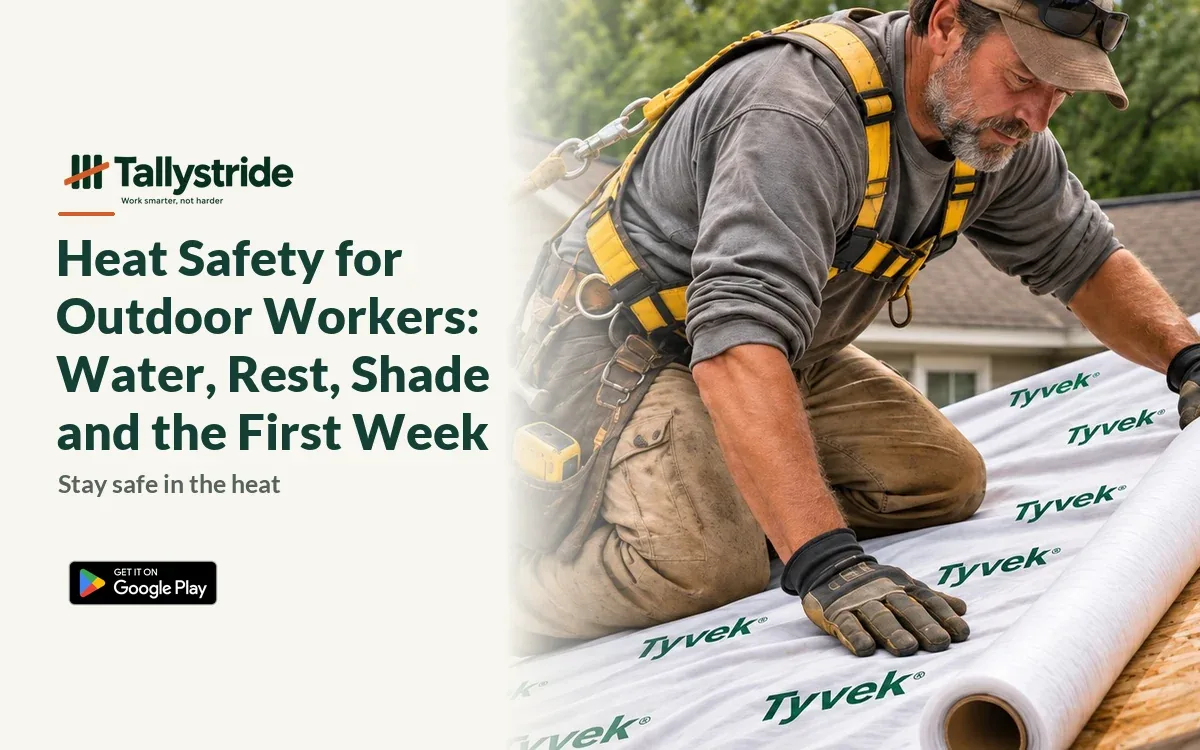
Heat Safety for Outdoor Workers: Water, Rest, Shade and the First Week
If you work outside for a living, heat isn’t a once-a-summer problem. It’s a daily math problem: how much sun, how much exertion, how much water, how much shade. Heat safety for outdoor workers matters whether you’re on a roof, laying asphalt, landscaping a yard, or running a delivery route, and it matters most in the first week of a hot stretch, not the fifth.
This post pulls from the OSHA heat overview page and the CDC/NIOSH heat stress page. It’s general information, not medical advice. If someone on your crew is showing serious symptoms, treat it as an emergency and get real medical help, not a blog post.
What counts as a heat-related illness
Your body is built to dump extra heat, mostly through sweating and extra blood flow to your skin. OSHA explains that this process, called heat dissipation, has to keep up with the heat your body is generating through work plus the heat coming in from the sun, the air, and whatever you’re standing next to, like a hot roof or a running compressor. When dissipation can’t keep pace, your internal temperature keeps climbing.
That climb shows up as a range of problems. OSHA lists thirst, irritability, a rash, cramping, heat exhaustion, and heat stroke as the symptoms that follow when the body can’t get rid of heat fast enough. CDC adds a few more to that list: heat stroke, heat exhaustion, rhabdomyolysis, heat cramps, and heat rashes all fall under occupational heat stress.
Heat also causes problems that aren’t illness exactly, but still get people hurt. CDC points to sweaty palms causing slips, fogged-up safety glasses, burns from touching hot equipment, and dizziness or fatigue that leads to carelessness around tools or edges. Loosening or removing PPE because it’s hot is on that list too, and it’s an easy habit to fall into when you’re sweating through a shirt by 10am.
The warning signs worth knowing cold
Heat stroke is the one that kills, and it moves fast. OSHA describes the signs as mental dysfunction: unconsciousness, confusion, disorientation, or slurred speech. If you see any of that in yourself or someone you’re working with, the instruction is blunt: cool the person down immediately and call 911. Don’t wait to see if it passes.
Earlier signs, the ones that give you a chance to act before it gets to that point, line up with the broader list above: thirst that won’t quit, irritability, cramping, a skin rash. None of those are normal parts of a workday. They’re your body telling you the cooling system is falling behind.
Who’s more likely to get hit
Some people run a higher risk than others on the same job, same day, same heat. CDC lists the personal risk factors as dehydration, physical exertion, PPE and clothing, physical condition and health problems, certain medications, advanced age, pregnancy, and a previous heat-related illness. OSHA’s list overlaps and adds lack of acclimatization and clothing that holds in body heat as occupational risk factors on top of the personal ones.
If you run a small crew, or even if it’s just you and a helper, this is worth a minute of thought before the job starts. Someone who had heat exhaustion last July isn’t starting from the same baseline as someone who’s never had it. Someone on certain medications isn’t either. You don’t need a medical file on every worker, but a quick conversation about who’s had trouble with heat before is cheap insurance.
Heat safety for outdoor workers: water, rest, shade
OSHA’s whole prevention message comes down to three words, and they mean it literally: water, rest, and shade as both prevention and treatment for heat-related illness.
Water means drinking enough, regularly, before you’re thirsty. Rest means actual breaks, not just slowing down while still standing in the sun. Shade means getting out of direct sun and away from heat sources, not just out of the worst of it. OSHA’s guidance specifically calls for frequent rest breaks in the shade or at least away from heat sources, which is a useful standard: if there’s no shade available, get away from the hot surface, the running engine, the reflective wall, anything adding heat on top of the sun.
This isn’t complicated advice, and that’s the point. You don’t need special gear to follow it. You need to actually stop, actually drink, and actually get out of the sun on a schedule, not just when someone finally says something.
The first week matters more than people think
If you haven’t been in heat lately, or you’re new to a hot-weather job, your body hasn’t built up tolerance yet. OSHA calls this acclimatization, and it flags the first few days in a warm or hot environment as the window where a worker needs extra care, not the fifth or tenth day.
During that window, OSHA’s advice for new or returning workers is specific. Employers should encourage them to consume adequate fluids, work shorter shifts, take frequent breaks, and quickly identify any heat illness symptoms. That’s not just a suggestion for someone else’s crew. If you’re a one-person operation coming back from two weeks indoors, or picking up a job in a hotter climate than you’re used to, you are that new worker. Treat your own first week outside the same way you’d treat a new hire’s: shorter days, more breaks, more water, and close attention to how you’re actually feeling instead of pushing through on habit.
CDC backs this up from the risk-factor side too: lack of acclimatization is listed as a risk factor for heat-related illness right alongside dehydration and physical exertion. It’s not a minor detail. It’s one of the main reasons people get hurt in the first week of a heat wave or a new outdoor job, even people who’ve worked outside for years.
Scheduling around the heat, not just through it
OSHA also points to schedule changes as a real control, not just a nice-to-have. The guidance mentions scheduling work for the morning or shorter shifts with frequent rest breaks as a way to keep body temperature down. If you can move the heaviest part of a roofing or paving job to early morning and push paperwork or lighter tasks to the afternoon, that’s a legitimate way to cut risk, not just a convenience.
This is also where keeping decent job records pays off twice. If you’re tracking when a job started, how long it ran, and when breaks happened, you’ve got a plain record of what the day actually looked like, which matters if a hot-weather job runs long or a client asks why a task that used to take four hours took six. An app like Tallystride can log that kind of start-stop-break detail for a work session without extra paperwork, which is one less thing to think about when you’re already managing the heat.
What to do if someone shows signs
If a worker or coworker shows the early signs, heavy sweating that suddenly stops, cramping, irritability, rash, don’t wait and see. Get them out of the sun, into shade or a cooled space, and get water into them. Stop the physical work completely, not just slow it down.
If you see the heat stroke signs, confusion, slurred speech, disorientation, or the person loses consciousness, that’s an emergency. OSHA’s instruction is direct: cool the person immediately and call 911. Don’t try to tough it out or wait for a supervisor’s call if you’re the one on site. A delay here is the difference the pages are warning about.
After the immediate problem is handled, it’s worth thinking about whether the schedule, the workload, or the lack of acclimatization time set the stage for it. If a new worker on a crew went down on day two, that’s a planning problem as much as a weather problem.
A few practical habits for a small operation
For a one-person trade or a small crew without a safety department, a few habits cover most of what the sources recommend:
- Start hot-weather jobs with extra water on hand, more than feels necessary, and drink on a schedule rather than waiting for thirst.
- Build in real breaks in shade or away from heat sources, especially in the first few days of a hot stretch or a new job.
- Treat your own first week in the heat, or any new worker’s first week, as a shorter-shift, more-breaks period, not business as usual.
- Watch for the early signs, thirst, irritability, cramping, rash, in yourself and anyone working with you, and stop activity if they show up.
- Know what you’ll do if someone shows confusion or slurred speech: cool them down and call 911 without delay.
None of this requires special equipment or a big budget. It requires paying attention and actually taking the breaks, which is often the harder part.
Heat safety isn’t the only paperwork-adjacent thing that gets pushed aside when a job is busy. If you’re also sorting out how to track vehicle use for hot-weather service calls, the comparison in mileage tracker app or paper log for contractors walks through what a usable mileage record actually needs. And if a hot summer season means more 1099 income to sort out later, 1099-NEC for contractors: who sends it and what to do with it covers what to do when those forms show up. Staying safe on site and staying organized afterward are different problems, but they’re both part of running your own work.
Sources
- OSHA heat overview: definition of heat-related illness, warning signs, water-rest-shade guidance, acclimatization advice for new workers, and the heat stroke emergency response.
- CDC/NIOSH heat stress page: definition of occupational heat stress, list of heat-related illnesses and heat-caused injuries, and personal risk factors.
Tallystride is free to download for Android, and Pro is a one-time purchase with no subscription.
Guarding your family, your business, your future.